If you’re considering a property purchase or home sale, I’ll help you navigate the market with the passion and experience only a true local professional can provide.
People often confuse architects and real estate developers, particularly when discussing custom homes, condominium towers or large urban projects. There is certainly overlap between the two professions, and they frequently work very closely together, but they tend to approach buildings from fundamentally different directions.
Having spent much of my life around both worlds, first growing up in a family of architects, later becoming an architect myself, while also working in construction, development, investment and real estate sales, I have always found the relationship between the two professions fascinating.
At their best, architects and developers challenge each other in productive ways.
An architect is generally focused on design integrity, proportion, livability, spatial experience and the long-term quality of a building. A developer, meanwhile, must constantly weigh economics, approvals, timing, financing, construction realities, marketability and risk. One is often trying to elevate a project; the other is trying to make sure it can actually survive reality.
Neither perspective is wrong.
In fact, great projects usually emerge when both sides respect what the other brings to the table.
Architecture school tends to leave permanent psychological scars in this regard.
At the University of Toronto Faculty of Architecture, we were taught very quickly that you were expected to have a reason for everything. Why is that window there? Why does the building turn that way? Why this material? Why that proportion? Unsupported design decisions were treated almost like moral failures during critiques.
“Contrived” was practically a swear word.
The underlying philosophy was that architecture should emerge from logic, context, functionality and clarity of thought — and that beauty could arise naturally from intelligence and restraint rather than arbitrary gestures. Sometimes painfully so, depending on which professor was dismantling your project that day.
Of course, architects do not always get the final word. Developers have lenders, investors, planning departments, construction costs and spreadsheets breathing down their necks. Architects sometimes have to comply with requests that they know are weakening a project architecturally: awkward layouts, undersized windows, arbitrary material substitutions, tortured massing exercises, or endless rounds of “value engineering” that slowly drain the life out of a design one compromise at a time.
At a certain point, one begins to sympathize with Miranda Priestly’s famous monologue in The Devil Wears Prada about cerulean blue sweaters. Design decisions that appear arbitrary to outsiders are often the result of countless layers of judgement, compromise, influence and downstream consequences. Nothing exists entirely in isolation.
Or, put another way, what may look like “just another condo tower” often contains years of arguments, negotiations, bruised egos, budget revisions and exhausted architects quietly trying to save a project from becoming the urban equivalent of Emily Charlton’s “ugly skirt convention.”
Learn more about the intersection of architecture, homeownership experience, and real estate with these posts next:
There is an old joke that some condominium towers begin as architecture and end as spreadsheet negotiations.
Occasionally, it feels true.
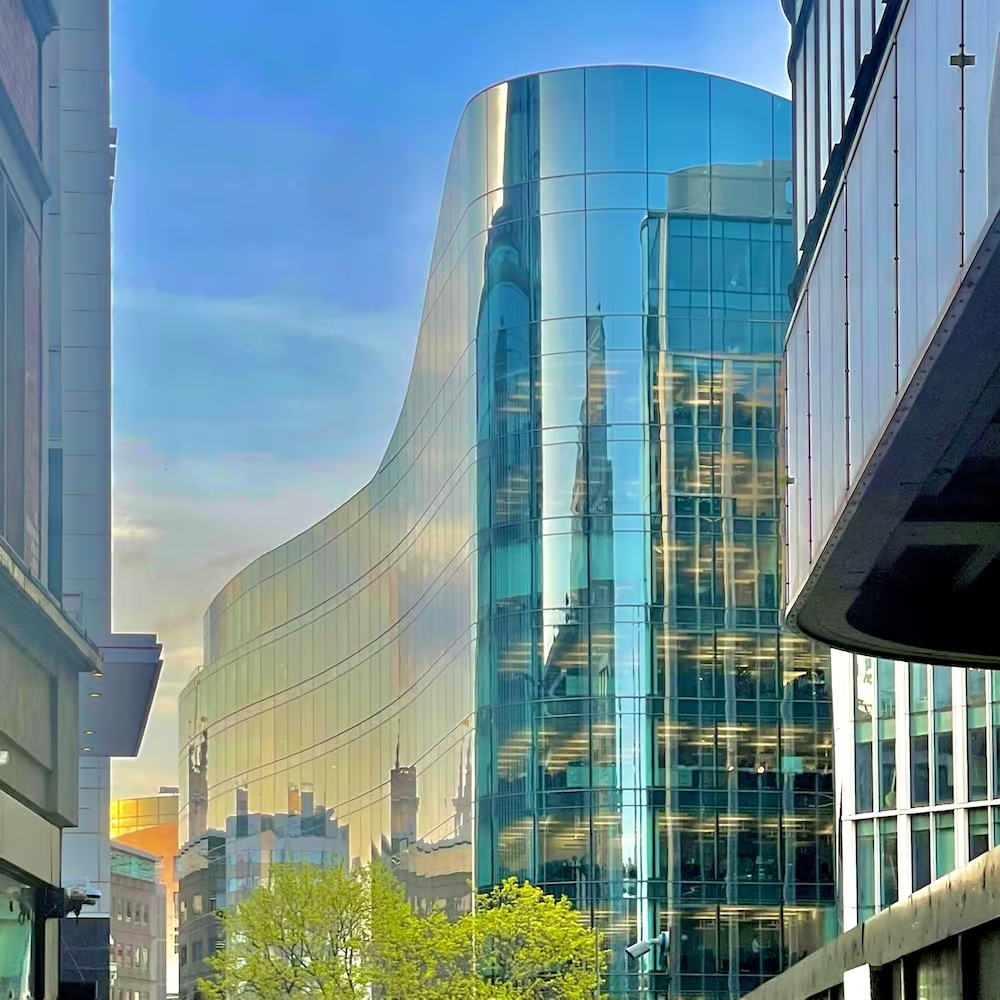
What makes this especially interesting is that many architects begin their careers producing thoughtful, intelligent and often beautiful work before eventually becoming absorbed into the machinery of large-scale global development, designing increasingly tall glass towers that bear little resemblance to the idealism that brought them into the profession in the first place.
That may sound cynical, but many architects would probably admit there is at least some truth in it.
And yet, great cities continue to remind us what can happen when ambitious clients genuinely trust talented architects.
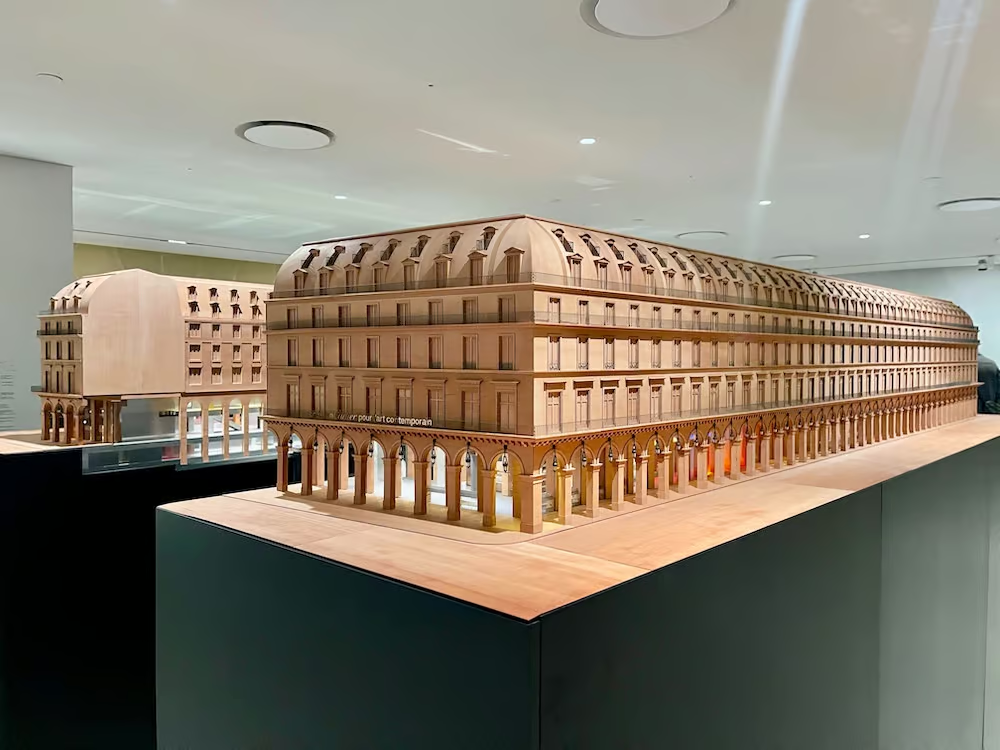
London has been particularly impressive in recent years. Despite all its contradictions and development pressures, there remains a culture there in which architecture, urbanism, history and contemporary life are often allowed to coexist in surprisingly intelligent ways. New York, at its best, can still produce extraordinary architecture when visionary clients allow architects to push beyond formulas and create buildings with genuine character and ambition. Paris, although operating at a much lower scale and under far tighter urban controls, continues to demonstrate how beauty, restraint, proportion and consistency can shape the emotional experience of an entire city over centuries.
Toronto, unfortunately, too often settles for expediency.
We have certainly produced some excellent architecture, and there are many talented architects and developers working here. But we have also normalized a tremendous amount of mediocrity — buildings designed primarily to maximize saleable area, investor appeal and construction efficiency rather than long-term urban quality or human experience. One occasionally suspects that somewhere deep within the approval process, an architect fought a heroic but ultimately doomed battle to prevent yet another glass tower from drifting into “ugly skirt convention” territory.
And yet, despite all the financial realities involved, people still instinctively respond to beauty, proportion, light, atmosphere and authenticity. They always have.
Even buyers who cannot fully articulate why they love a particular space usually feel immediately when something has been done well.
That overlap between architecture, development and emotional response is part of what eventually drew me toward real estate representation.
Long before I became a real estate broker, I had already spent decades immersed in architecture, construction and property conversations. As a child, I helped my mother with aspects of her real estate work, and while home from university one summer I completed my real estate licensing courses. Even then, I was fascinated not only by architecture itself, but by the way people emotionally respond to houses, neighbourhoods and spaces.
Here are a few more posts you might find interesting:
Those experiences continue to shape how I work with clients today.
My background as an architect and builder influences how I evaluate houses, renovations, additions and development potential. It also changes how I market and represent properties. When dealing with architecturally significant or unusual homes, understanding the design thinking behind a property often becomes just as important as understanding comparable sales or market statistics.
Buyers tend to sense fairly quickly whether the person representing a house genuinely understands it.
That is especially true in Toronto, where buyers at the upper end of the market are increasingly design-conscious and globally aware. They are not simply purchasing square footage. They are responding to atmosphere, craftsmanship, setting, proportion and the emotional experience of living in a space.
In many ways, architecture, development and real estate all revolve around the same underlying question:
How do people actually want to live?
The approaches may differ considerably, but the best outcomes usually happen when intelligent design, practical execution and thoughtful representation all work together.
If this approach resonates and you’re thinking about your next purchase or sale, I would love to chat more. Get in touch with me today by filling out the form on this page, calling me, or sending me an email directly.